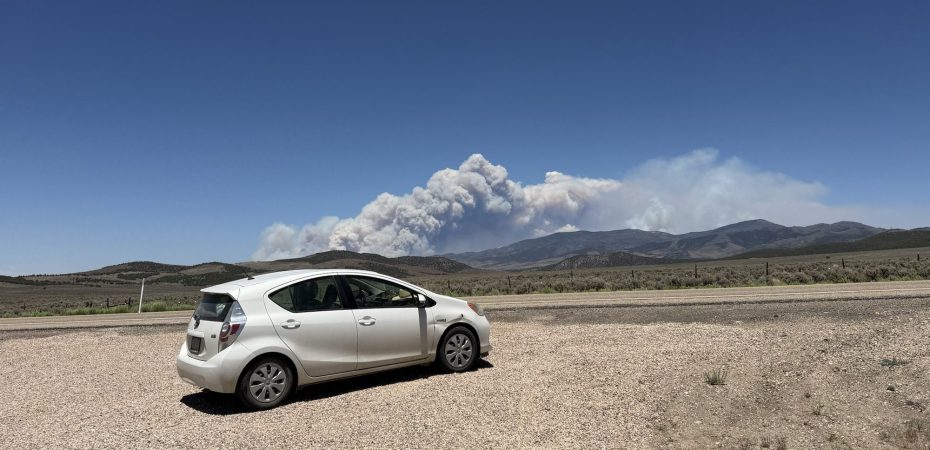
We left our home in Page, Arizona on a Sunday, excited to escape the lingering wildfire smoke that has been hanging over town for the last week or so. The Rock Canyon Fire was started by lightning on the Arizona-Utah border and burned up to 4,800 acres.
By now, we are experts at packing the smallest model of Prius ever made to the brim. We shoved our tent, sleeping bags, pads, and cooler in the footwell of the backseat so the dogs could lounge in their plush tempurpedic beds on top of the seats. The trunk was packed with a bin, suitcase, shoes, dog food, and snacks.
We headed north for Utah, on our way to a travel conference for our new business, Pronghorn Expeditions. The bin was full of our booth set up: t-shirts, fliers, tablecloth, standing photos, etc.
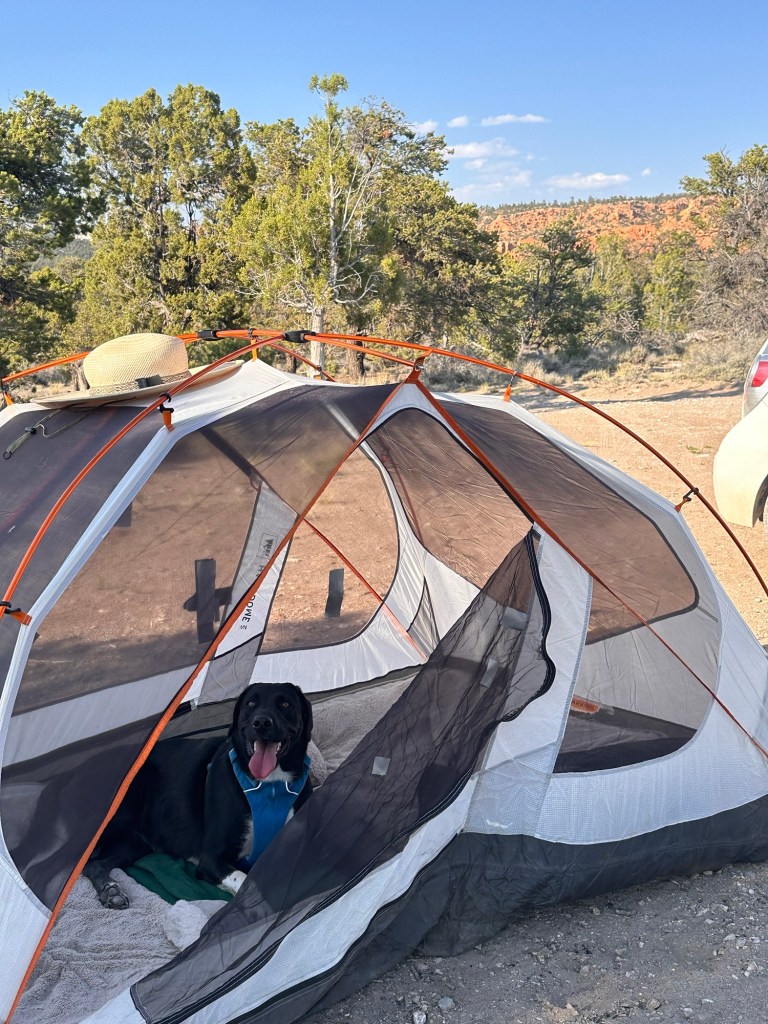
To break up the six hour drive, we camped at the base of the pink Claron formation near Bryce Canyon in the pinyon-juniper forest.
Either Disco got lucky or she discovered the button that rolls down the window because once we parked, she leapt from the open window to chase a squirrel. A window I had just rolled up. She’s our rapscallion dog.
The dogs roamed the campsite off-leash since no one was around for miles.
When we set up camp, Jaden realized that his sleeping pad had a hole in it, so he arranged the dog beds into a bed for himself in the tent. Disco wasn’t going to sleep on the ground, no. She planted herself on her mattress nuzzled in between Jaden’s legs, while Mallow and I slept in the dirt outside of the tent.
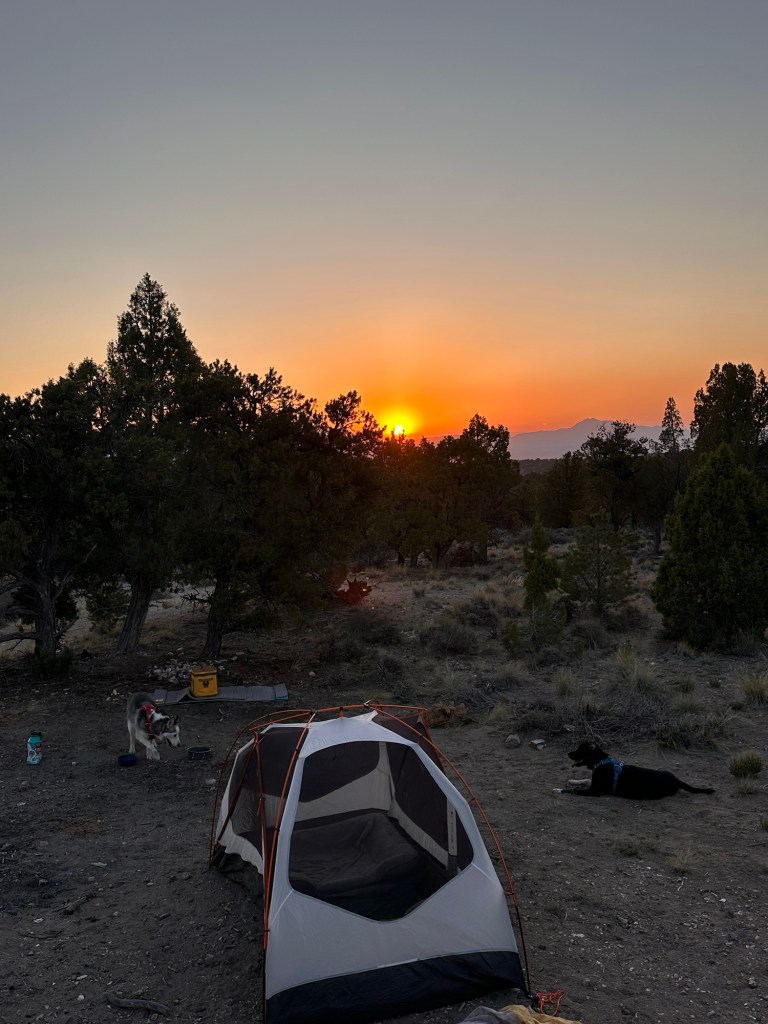
We awoke to a strange noise in the night. I could see Jaden’s silhouette was sitting up too, listening to the sound.
“What was that?” I asked.
“I have no idea,” Jaden said, which was an unusual response from him. His mind is an encyclopedia of animal calls.
Mallow was awake, standing in the clearing at the edge of her leash, looking up to the sky, jumping as a large winged creature swooped down to tease her by flying close to her head.
“That is a massive bat,” Jaden said.
“Could the bat have made that sound?” I asked. There was some chirping in the distance, then right above our heads it sounded like a truck engine break or a train.
But we were nowhere close to train tracks or a highway.
The next morning when we drove into cell phone service, Jaden Googled the question: Are there big bats in Utah that make sounds like a train?
Google’s AI response was: No. There are no big bats in Utah. The largest bat in Utah is a Mexican Freetail Bat, with a wingspan of 12-16 inches.
“12-16 inches?! That’s huge!” I laughed.
The biggest bat I’d ever seen was maybe half that size. I took this as an opportunity to lecture Jaden about making the switch from Google to a different search engine. (Did you know DuckDuckGo and Ecosia search engines have the ability to turn off AI responses?).
We traveled north on two lane backroads instead of the highway.
100 miles south of Salt Lake City, we encountered a plume of purple, orange, red and white clouds over the mountains near Eureka, Utah. But it wasn’t a cloud.
It was a massive wildfire burning over 15,000 acres in twenty-four hours. The mountain on fire looked like an active volcano. I couldn’t see flames but could see the smoke continuously rising from the peak.
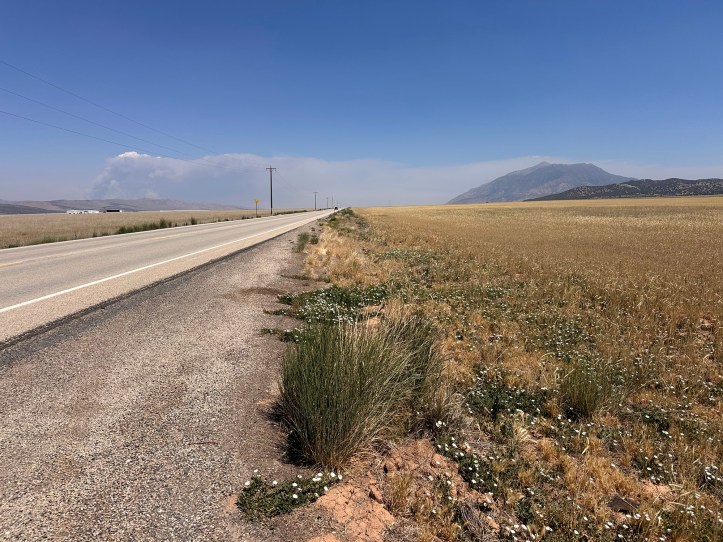
Being from the East Coast, seeing a wildfire still amazes me. I can’t look away. It’s one of those things that’s terrifyingly beautiful. The power is unparalleled. The raw energy of flames is palpable.
“I’m sick of it,” Jaden said, who grew up in the West accustomed to wildfires each summer.
A smaller fire, the Bonneville Fire, broke out a few miles from our Airbnb above the University of Utah in Salt Lake City. For the next few days, we watched fire crews suppress the flames, leaving a blackened hillside behind.
We learned later that night that another fire, The Cottonwood Fire, broke out along the highway behind us that same day. Showing extreme behavior, the fire grew more than 20,000 acres in less than twenty-four hours.
People we met at the conference in Salt Lake had vacation homes burn down, others awaited news.
Most of our time in Salt Lake was enshrouded in smoke. We couldn’t see the mountains. The smoke burned my eyes. We limited our time outside.
Seven more fires broke out the same week.
On our way home, we drove past the Cottonwood Fire, which had grown to over 90,000 acres.
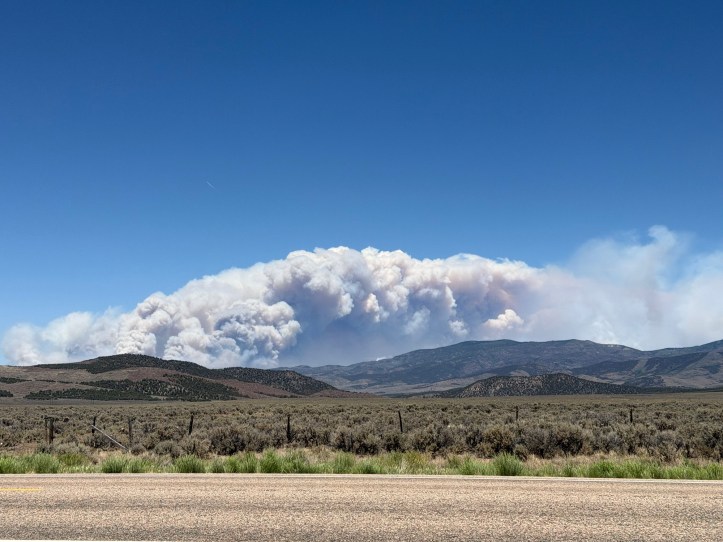
I couldn’t look away. This time I could see the flames. I could see ponderosa pines on fire. From the passenger seat, I stared with my mouth hung open and took blurry pictures through the dirty windshield. We could see the plume of smoke for three hours. I have never seen so many colors in smoke before.
At the base of the mountain were dancing orange and red flames with plumes of white smoke.
As my eyes traveled up the clouds, the colors shifted from white to magenta, maroon, and in some spots: jet black smoke, which meant structure fires- cabins, homes, buildings on fire.
By the time we made it home, the Rock Canyon Fire on the border of Utah/Arizona was 99% contained and all the fire crews were en route to the Cottonwood Fire.
When I checked social media, the only posts on my feed seemed to be pictures of blood red skies and mountains on fire.
Extreme winds aggravated each fire and slowed down efforts to contain them. A small fire (The Cherry Fire) broke out near the Iron Fire, and within two days they merged into one mega-fire with a combined acreage of over 70,000 acres.
Videos of families evacuating through burning highways and animals running through burning forests broke my heart.
This past winter was recorded as the worst snowpack on record for Utah, a major factor in these extreme fires.
We arrived home in Page to clear skies with healthy air quality and breathed a sigh of relief (for now). The Pocket Fire in Sedona doubled in size overnight and Flagstaff, just two hours south of us, was engulfed in smoke, which may travel to us soon.
Utah’s governor has declared a state of emergency and has asked people to pray for rain. Although, it did rain while we were in Salt Lake, and lightning started both the Cherry Creek and Cottonwood Fire. More than prayers, our country needs serious climate action laws.
Earlier this year, the Trump administration and DOGE fired thousands of US Forest Service employees, including hundreds of wildland firefighters ahead of what is now being called one of the most dangerous fire seasons in history.
Other public land protectors and educators have been on the chopping block, including National Park employees. In response to the illegal layoffs, National Park employees at Glacier, Grand Canyon, Grand Teton and eight other parks just voted to unionize. I hope the Forest Service follows suit.
Since the federal government has done everything they can to weaken public lands protection and fire the employees who care for the land, now more than ever it’s important that citizens help support public lands by checking/respecting fire restrictions and drowning campfires before leaving if the area is not on fire ban.
Not only have employees been cut, but funding has been frozen or taken away. Now more than ever, wildland firefighters could use our support.
Here’s a list of places you can donate that directly help wildland firefighters:
- Wildland Fire Foundation
- Grassroots Wildland Firefighters
- Firefighters United for Safety, Ethics & Ecology (FUSEE)
Other ways you can support:
- Subscribe to the Hotshot Wake Up Substack to stay up to date (free and paid options)
- Wildland firefighting job search
- Download the WatchDuty app to stay up to date on fire statuses, restrictions, and evacuations
- More resources here.

