
I left my home in Page, AZ at the beginning of July at the tail end of the France Canyon Fire’s lifespan. It burned 34,000 acres in Bryce Canyon throughout the month of June, bringing smoke into the Lake Powell region at the same time that Navajo Mountain was on fire. So if the wind blew east or west, we were inhaling the fumes of our beloved Bristlecones, oaks, aspens, spruces, and pines.
For weeks I watched planes scoop water out of out of Lake Powell during another dangerously low water year to fight the encroaching wildfires.
After sixteen days of breathing thick smoky air, my throat swelled up to the size of a golf ball on one side. It hurt to swallow, talk, and I could barely stay awake for more than a few hours.
The doctor tested me for strep throat and it came back negative.
“I’m going to treat you for strep anyway,” he said.
“Could it be the smoke?” I asked.
“Could be. Are you exercising outside a lot?”
“Yep,” I snorted, not at all in a haha funny kind of way. I was working up to 12 hour shifts carrying kayaks up and down The Mother of AssKicking Hill and paddling 5 miles a day without a mask or much thought of the dangers the smoke posed.
A few days of sleep and antibiotics later, I was back at work.
Thanks to the wildland firefighters, the France Canyon Fire seemed to be inching closer and closer to 100% contained by early July. Finally, blue skies returned.
For one day.
I remember walking outside my front door and smelling it again. A scent I almost want to like, a smell that reminds me of happy memories around a campfire, but it’s tinged with a plastic-like odor. A tad sweet like the vanilla bark of ponderosa and spruce, but there’s something unsettling about it too. A familiar odor with a touch of too many chemicals.
In the grocery store parking lot on July 4, I saw huge plume of dark clouds with a red underbelly rise above the Vermillion Cliffs. The smoke was coming not from the north in the Bryce Canyon region but from the southwest, near the North Rim of the Grand Canyon.
“Shit,” I said, pointing to the unusually dark crimson sun. My niece and nephew stood next to me in the parking lot watching in awe.

“Another fire?” my nephew asked.
“Yep. Time to go,” I said.
The Dragon Bravo fire in the Grand Canyon continued to grow throughout the month of July. It is now considered the biggest wildfire in the country. It’s classified as a megafire and has exceeded 130,000 acres. The fire is so powerful that the clouds reach 24,000 feet into the air and the fire itself is creating its own weather. (For reference, Russia’s Klyuchevskoy Volcano erupted this week after massive earthquake and shot ash only 9,000 feet into the sky).
Watching all of this unfold through Instagram, Facebook, and the Watch-Duty app was surreal. It was difficult to grasp the magnitude of loss and destruction.
I planned to take most of July off for school and family time, so when I returned to Page on July 30- the Dragon Bravo Fire was making a massive run.
In just a few hours it grew more 30,000 acres. The edges of the smoke reached southern Colorado. I could see the trail of smoke traveling north for more than 100 miles. It concealed familiar mesas, mountains, and rock outcroppings. It looked like a sturdy wall that could not be penetrated.
My knuckles gripped the steering wheel so tight they turned white. The logical side of my brain urged me to turn around. Don’t go into that smoke.
But my home, my job, and my community was behind the veil of smoke. I felt like I had to return.
Nothing I saw on my phone could accurately prepare me for what I was walking into. The air quality map on my weather app warned: Hazardous air. Everyone will be affected.
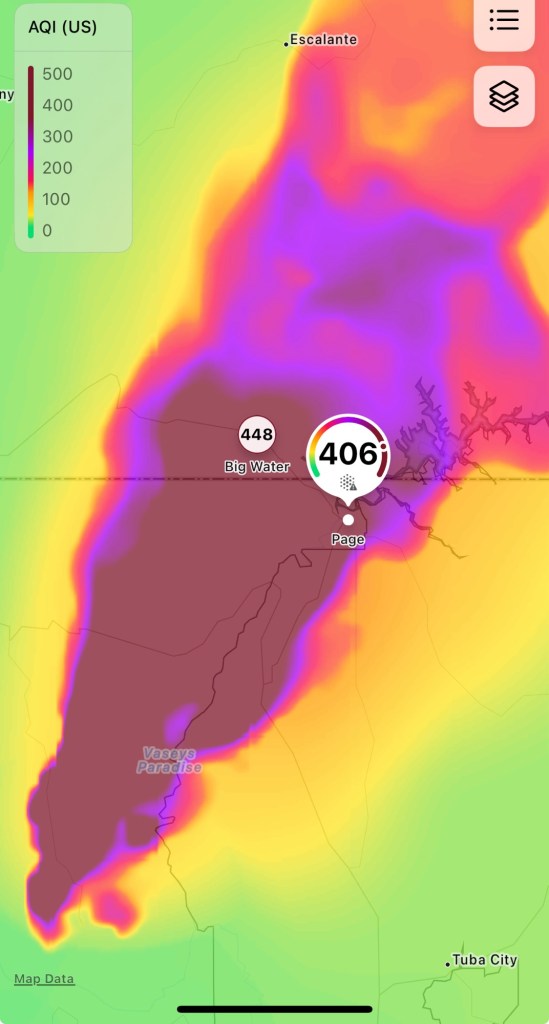
Tucking the strings of a mask behind my ears, I stepped out of the car into a hazy, charred atmosphere. My eyes watered and burned. A scratch in the back of my throat appeared. The air tasted burnt, old, and acrid.
Shit. Shit. Shit.
The red rocks looked gray compared to the glowing sky.
What disturbed me most was the people outside of their cars rocking their babies, sitting on picnic blankets, chasing their dogs, and taking selfies with the sun. Not only was the temperature over 100 degrees, the air quality was over 400.
The world was literally on fire- the destruction of habitat and clean air was visible and visceral yet no one seemed to mind. I wondered what it will take for people to look up and acknowledge that something isn’t right.
Facebook posts from people in town that day had captions that read: The smoke sure makes the sunsets beautiful!
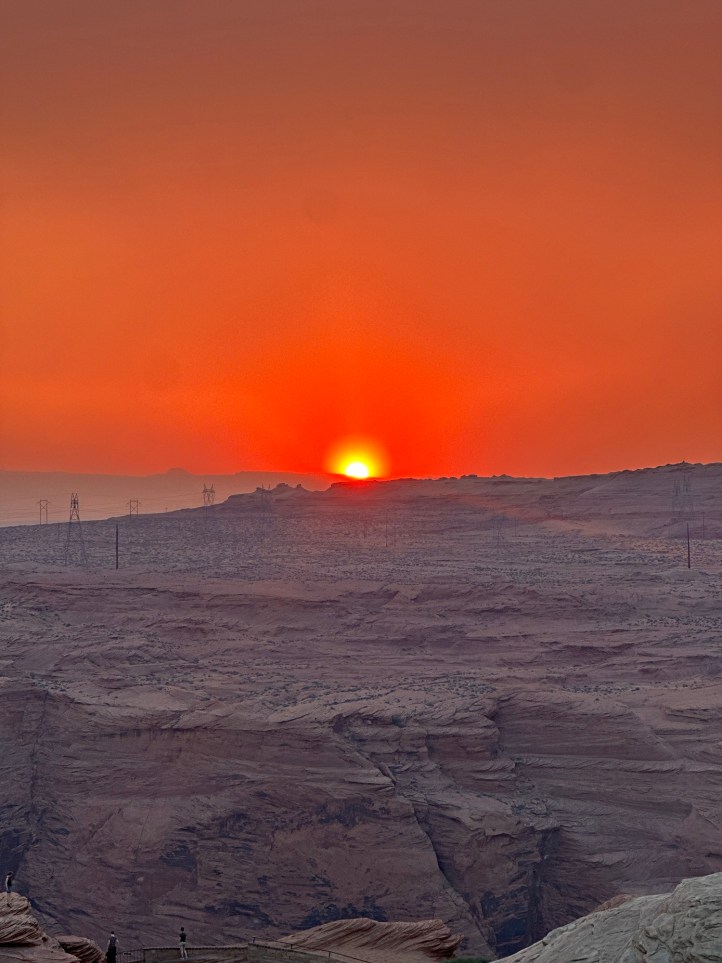
I can get behind seeing beauty in the destruction, but an uneasy feeling settled in my gut as I noticed people looking at me funny because I was the only one wearing a mask.
It felt like I stepped into a dystopian hell as a group of tourists filmed a TikTok dance with flames raging in the background.
Day old ash lingered in the concrete cracks at the overlook where tourists held up peace signs with their ass cheeks hanging out of their shorts.
Maybe they don’t know. Maybe they have never seen a wildfire. Maybe they think the plume of black smoke is a cloud. Maybe they are uneducated on the risks of particulate matter entering the bloodstream from wildfire smoke. Maybe they don’t give enough fucks to look up and wonder why the sky is red. Maybe people are so callused to the natural disasters of the world they don’t care anymore.
Maybe they don’t want to believe that the air is toxic or that they are in any sort of danger. Maybe they are hoping they won’t be affected. Maybe they don’t want to change their vacation plans. Maybe no one wants to inconvenienced by yet another “natural” disaster.
Maybe we are all a bit exhausted by the onslaught on climate chaos.
Unfortunately we could not ignore the onslaught of smoke in our lungs. Our little Disco puppy woke up displaying symptoms of wildfire smoke- confusion, lethargy, uncoordinated gait, behavioral change or lack of personality and the list goes on.
My stomach was twisting, my lungs were agitated, and eyes itched. When we went outside we could watch smoke drift down our street over our canoes and cars.
We spent three days in the smoke before deciding to leave. Our symptoms improved once we breathed clean air for 30ish hours.
We are so lucky so have family who welcome us with open arms and are safely in Florida figuring out our next steps.
Until then, pray for rain, dance for rain, concoct potions for rain, whatever you do- think of the forests we are losing. Think of the firefighters out there protecting our natural world. And if you’re somewhere without wildfire smoke, take a deep breathe in of wonderfully clean, fresh air.
More Wildfire Resources
- Read the HotShot Wake Up newsletter that reports on wildfires across the country. Free to read but a paid subscription supports firefighters
- Dragon Bravo Fire becomes Arizona’s 7th largest wildfire since 1990
- What Travelers to Grand Canyon Need to Know by the NY Times
- Download the wildfire app “WatchDuty” to stay up to date on fires near you
 Beth Henshaw
Beth, so glad you left but so sad you had to. Safe travels and take care!Love ya
Sent from Yahoo Mail for iPhone
LikeLike
Love you too and thanks for always reading 🙂
LikeLike