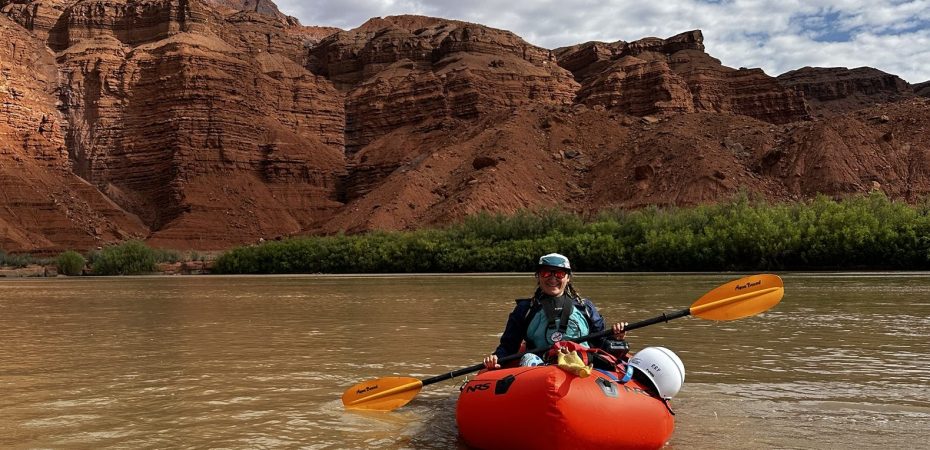
In May 2025, I joined the Returning Rapids Project on a river trip. We paddled the lowest section of the San Juan River, the most remote and unexplored section of river in all of Utah.
When Lake Powell was 100% full from 1980-1983, the reservoir covered 60 miles of the San Juan River all the way to Clay Hills Crossing, where our trip began.
Lake Powell was 31% of full pool during our trip, meaning 35 miles of the San Juan River was exposed. We launched onto a moving river at Clay Hills, where the reservoir once backed up with still water and big, open bays.
We paddled a section of river that many thought would never be seen again. A place that’s been under Lake Powell for most of my life.
It was a trip of firsts for me: the first time I ever paddled a packraft, the first time I saw this section of Glen Canyon, and the first time I ever saw a river die into a reservoir.
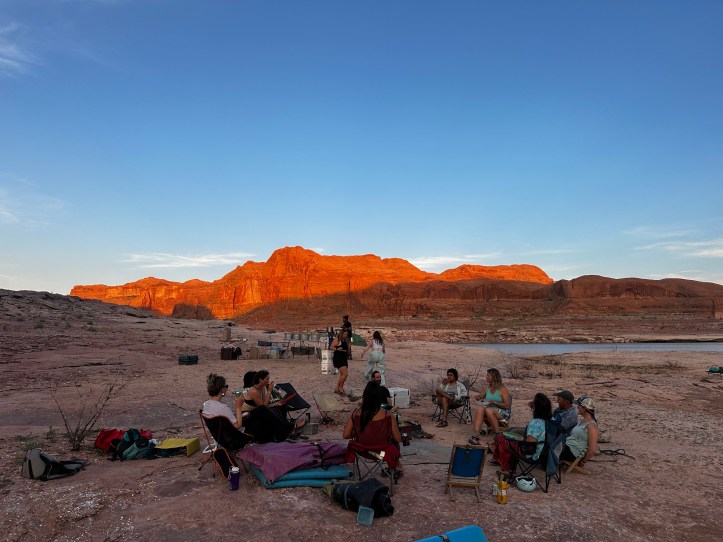
Part of the magic of river trips is strangers becoming friends quickly. It only took a few days for everyone on the trip to learn about Ian, my partner who went missing in the mountains of Colorado in summer 2023.
A woman sitting across the campfire looked at me and said, “I didn’t know you were Ian’s partner. I worked with him at Deer Hill Expeditions.”
Deer Hill is a guiding company based out of Mancos, Colorado. Ian’s first job in the area, a few years before we met.
More recognition followed.
“We had friends go to that search,” one couple said.
“My friend stayed with me the night before he went to search. Do you know Eli?”
Eli, one of my best buddies. Roommates with me and Ian and the man who drove me across the country after the search so I could be with my family.
This group of strangers suddenly felt like distant relatives, sharing more connections that we knew. Separated by a thin veil. Nearly everyone on the trip had heard of the search, and looked at me with more understanding.
In fall 2023, it was discovered that Ian drowned in the West Mancos Creek, a tributary of the San Juan River. A group of friends spread some of Ian’s ashes near the Upper section of the San Juan that Thanksgiving. Speaking his name and telling his story felt like an appropriate recognition of his palpable presence in the canyon.
Just as the San Juan River was re-emerging from under Lake Powell, I too felt exposed.
Approaching Stick Riffle
On our fourth and final day of paddling the river before we hit the reservoir, the girls in packrafts floated behind Returning Rapid’s crew members rowing metal skiffs.
“You don’t have to answer this if you don’t want to talk about it. I’m just curious how your relationship with nature has changed since Ian died,” Sarah asked in the blue packraft beside me.
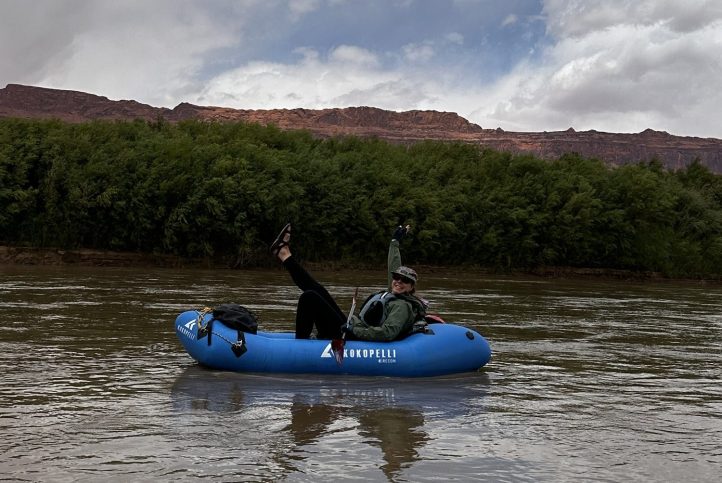
A river without rapids is ideal for these kinds of conversations.
“I love that question,” I said, raising my paddle out of the water to float. “It’s changed a lot…”
Nearly two years ago, Ian’s remains and spirit traveled down this section of river and carried him into Lake Powell. And here I am, still following him deeper into the desert.
Lost in thought, I looked at Sarah who was patiently waiting for my response.
“I notice that I’m more anxious and less confident. Like when it was raining the other day, that wouldn’t have bothered me before. But I felt unreasonably tense. I was looking at the sky thinking: what if it never stops raining and everything floods and this whole trip is terrible?”
“Ah, I see,” Sarah said.
“Which is ridiculous. I’ve been a backcountry guide for ten years. I’ve been in way worse storms for way longer. But now it’s like, I forget that,” I said and Sarah nodded.
“Stick Riffle up ahead,” a boater called to us from downstream.
Stick Riffle is a series of drowned oak trees that grew during lower water years in 2020-2022. When Lake Powell receded, the oaks wasted no time growing in the water’s absence.
The Returning Rapids crew said they felt hopeful when they saw these native trees coming back to life without human’s help, evidence that the drowned Glen Canyon ecosystem is capable of re-establishing itself.
Their sorrow to see the oak trees underwater was contagious.
The famous water year of 2023 changed everything. For me and the river.
Snowpack in the Colorado basin that feeds the San Juan River and Lake Powell was more than 160% above average that winter.
When the snow started melting, Lake Powell rose 1-1.5 feet a day.
What was good for our water system wasn’t good for me- those same floodwaters of melting snow claimed Ian’s life, as the creek he crossed rose to more than 8x its average flow.
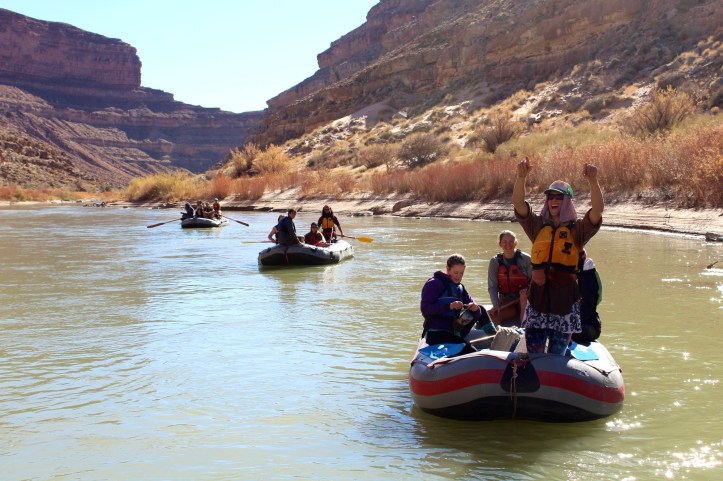
Stick Riffle, Right Around the Corner
“Something I’m working on is having fun outside again,” I said to Sarah as we continued to float toward Stick Riffle.
I continued, “On the first day when we encountered those rapids, I was so scared when we scouted them. All I could picture was me flipping, which wouldn’t have mattered because the river was only a foot deep and I could just stand up. Before Ian died, I would’ve been like hell yeah I got this let’s go! And then I probably would’ve flipped and laughed my ass off.”
“That makes so much sense,” Sarah nodded. Sarah rowed the Grand Canyon twelve times and has extensive whitewater experience. I followed her line through the rapids on the first day, wishing I had her confidence to whoop and holler through the rapid. Instead, my knuckles went white and my teeth were clenched.
Even the impending approach of Stick Riffle put a knot in my stomach.
What if I can’t do it?
As we floated closer, I told Sarah about how 2023 was my year of loss. Two months before Ian died, our van was stolen with everything we owned in it.
“Oh my god, girl,” Sarah said, and I nodded, laughing a little.
“All my clothes and gear were stolen. I still feel like I’m rebuilding my identity from that. How am I supposed to be a backpacker without a backpack? A biker without a bike? I still haven’t recovered. I don’t have a bike anymore, but now I have this packraft. So…a new identity is taking shape.”
“That’s beautiful,” Sarah said.
We talked about how grief and loss never really goes away.
“Our bodies remember,” Sarah said.
“Oh, definitely,” I nodded.
We talked about how grief isn’t talked about enough. How uncomfortable people feel when it is brought up.
“Stick riffle, right around the corner,” a boater downstream shouted and we nodded, picking our paddles off our laps. The river was bending quickly, obstructing sight downstream. It was fun to paddle the twists and turns. For the first time on the trip, I was the first packraft in line.
“Do you want me to go ahead of you?” Sarah asked, reading my mind.
“No, I got this,” I said, synching the strap on Rubber Chicken tighter.
“Yeah you do! Go girlypop!” she cheered.
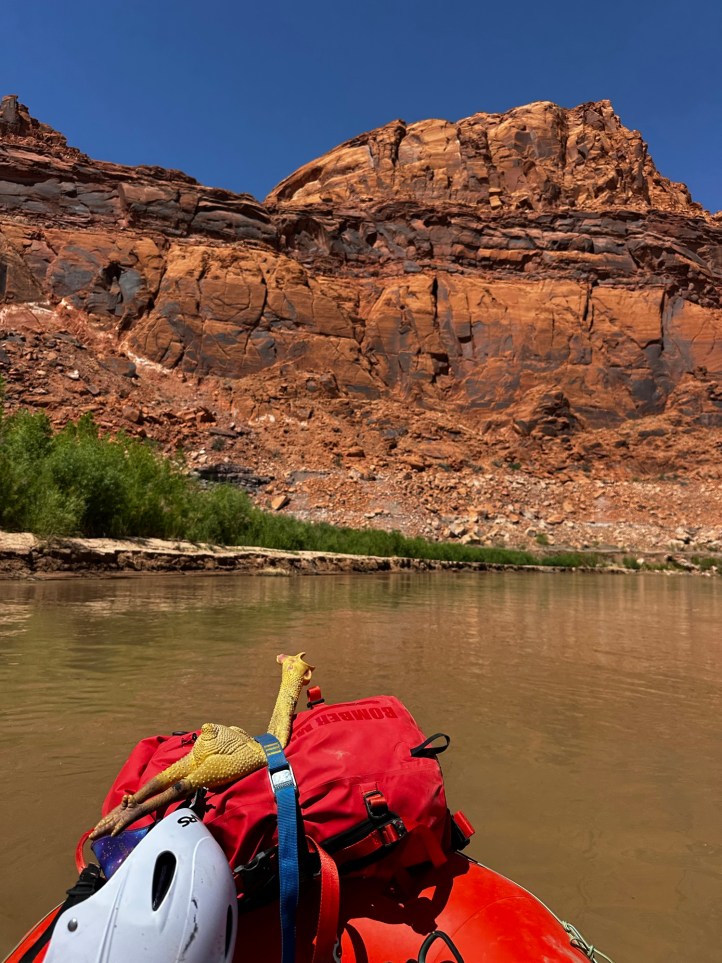
Stick Riffle
Rounding the corner, I laid eyes on Stick Riffle. The oak trees who took root were still standing under several feet of river water. The top branches poked out, creating a wavy riffle of moving water to paddle through.
I can do this.
The crowns of the dead oak trees wobbled in the moving river, like the inflatable tube men dancing outside of car dealerships.
Not only can I do this, I can have fun.
The sticks were inherently funny looking, shimmying and shaking as water passed through. Mocking my anxiety.
Why would I ever be afraid of this?
There were a clear set of waves that wove through the sticks. At the beginning of the trip, I might have tried to go to the side.
Instead, I hit the waves dead on and let out a “Woohoo!” as I bobbed over each one. I winked at the section of sticks who resembled a Nascar crowd waving and cheering me on.
Sarah let out a Woo! behind me.
The sticks waved goodbye and the calm water returned. Our eyes met and we giggled.
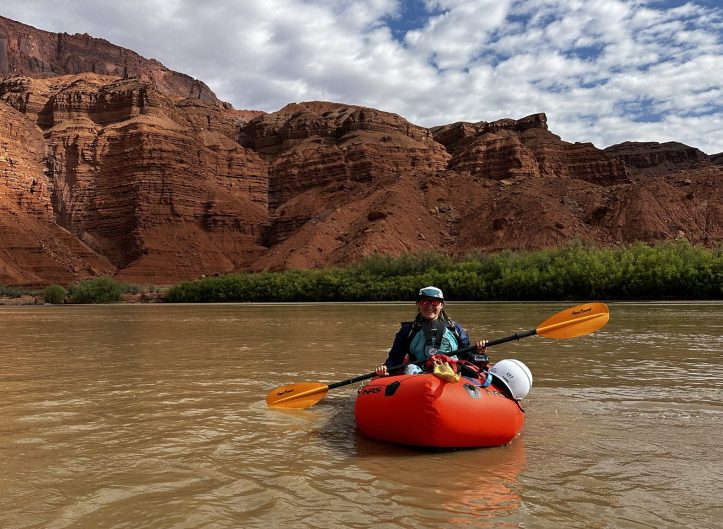
I felt myself coming alive in a landscape that was dying.
Not long after Stick Riffle, the San Juan River stopped flowing as it met the reservoir.
The lush green banks of sand holding willow, cottonwood, and tamarisk in place disappeared. Lake Powell’s still water spread out from wall to wall. Sticks, mud, and debris caked the surface of the water. Beached buoys, crusty coolers, and beer cans littered the boulders that were once under the lake. Bird song stopped and Wind had no leaves to rustle.
Stay tuned to read next week’s post- more on this trip and the emotional experience of seeing a river die into a reservoir. Thanks for reading!
 Beth Henshaw
Loved this one so much, you go girl ♥️
Get Outlook for iOShttps://aka.ms/o0ukef
LikeLike
Thank you for sharing this journey, both on the water and within yourself. Your honesty about grief, resilience, and learning to trust nature (and yourself) again is deeply moving. The image of the “dancing sticks” made me smile, a perfect reminder that we can find small moments of courage and even joy, even in places that hold our hardest memories. 💙
LikeLike