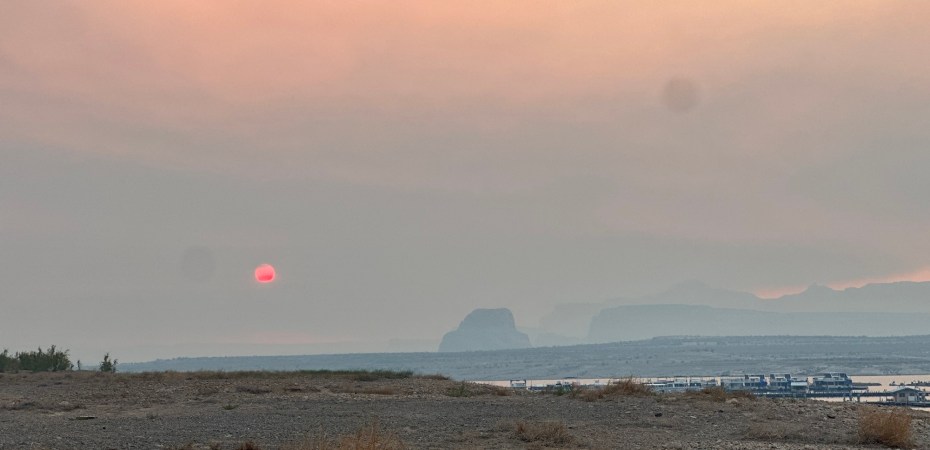
A scratch in my throat accompanies each paddle stroke in deep water. Smoke conceals the red and pink cliffs in a haze. The landscape looks more white than orange. The blue mountain is gone. Tourists don’t even know it’s there.
Sixteen days of burning trees is enough to break my heart.
Pinion, juniper, and sage in flames.
Spruce, aspen, oak in flames.
Precious bristlecone pines- 1,600 years on earth abruptly erupting in flames.
I watch in awe as helicopters fly low over the lake with buckets dangling from a rope. Buckets that seem small but can hold up to 2,000 gallons. They scoop overallocated Colorado River water and carry it to the forests- but which way will they head?
Two fires are burning simultaneously.
One to the east, on the blue mountain made of volcanic stone.
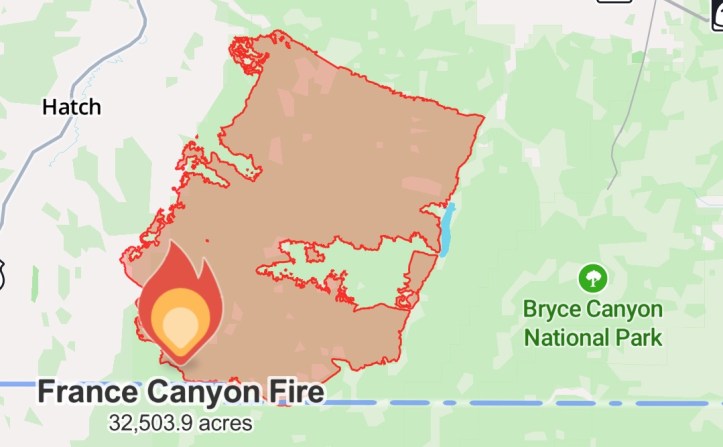
The other in the west, near Bryce Canyon National Park.
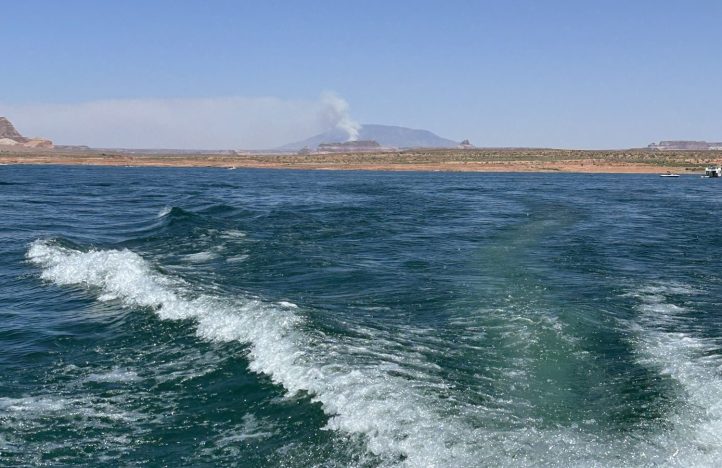
I was motor boating on the lake the day Navajo Mountain caught fire. On the water, it is impossible to see past the towers of rock that rise above us.
“Look! Smoke,” I said, mouth wide open. “Must be a houseboat,” I assumed. Lake Powell is covered in water and stone, not forests. The most common fires on the lake are electrical.
Three Black Hawk helicopters flew low over the water in the direction of the smoke.
“The smoke looks blue,” I said as we motored back to Page.
“That usually means trees. Not chemicals,” Jaden said, looking over his shoulder at the plume of smoke that continued to rise into a cloudless sky.
It wasn’t until we got off the lake that we could clearly see the smoke rushing up from a canyon on the beloved blue mountain.
The next day I went to work as if the world wasn’t on fire.
It became clear that some people at the ramp didn’t identify that smell as smoke. Most were not outside last night to see the mountain glowing like embers in a campfire.
Sometimes Lake Powell users are more focused on their tan than the land, so I started talking about the fire to guests and locals. Pointing out the missing mountain. Pointing out the clouds over the Karparowitz Plateau.
“See that? That’s smoke, not clouds.”
“Oh, my.”
“Oh, shit.”
“That’s terrible.”
Terrible, indeed.
Each day, I go to the ramp that sits above the low lake that’s supposed to be rising. I pull kayaks off the trailer, one by one. This dry winter broke records.
I clip seats into the plastic boats. Snowpack for the Colorado River Basin is 3% of average for this time of year. I wheel a kayak down the concrete ramp. The lake is down 22 feet from this time last year.
I walk back up the ramp to retrieve another kayak. The lake has only risen 3.8 feet this year. I ask the employee on rentals for help carrying my boats two at a time down the Mother of All AssKicking Hills. Last year the lake rose 22 feet.
We slip on the sand and trip on rocks but the kayaks make it to the water. The year before, the lake rose 70 feet. We carry more boats down. The snow isn’t coming this year.
Once all the boats are staged, I jump in the water to cool off. I think of the suffocating heat firefighters must feel in those suits. At the top of the ramp, I sigh when I see someone forgot to restock the cooler with ice. I pull paddles out of the trailer. I grimace at the forecasted wind. I set them neatly against the concrete barriers.
Steady 25 mph with gusts up to 40 mph every afternoon. The perfect conditions for the fire to grow. If I have extra time, I check in on the disaster. Being informed feels like the least I can do.
At first, 2,000 acres were burning with 0% containment.
“Does that mean no one’s doing anything about it?” a co-worker asked.
“No, it means the fire is winning.”
Two days later, 7,000 acres. Helicopters and airplanes, smokejumpers, ground crews working to control the spread.
A week later, 17,000 acres were burning and a new fire erupted outside of St. George, turning homes into ashes.
400 people, then 600 people now 800 firefighters doing their best outside of Bryce Canyon.
After two weeks, 34,000 acres burn with only 18% containment.
We need rain.
“Probably started by some idiot tourist who didn’t put out their campfire,” I heard someone say. Not just any rain, we need hard monsoon rain.
What was the cause of both fires?
Lightning. From monsoon thunderstorms.
All data on Lake Powell’s water levels come from Lake Powell Water Database.
 Beth Henshaw
“The next day I went to work as if the world wasn’t on fire.” Our motto for these times.
LikeLike
Sadly, yes. Thanks for reading, Karen!
LikeLike