Yesterday a man killed a baby rattlesnake in Antelope Canyon. Not to protect himself. Not because he was afraid. Not because anyone was in danger of getting bit. For fun.
He was seen carrying the snake out of the canyon like a trophy. His girlfriend also flaunted a lizard she killed. When approached by a guide, the man became defensive.
“This isn’t anyone’s canyon,” Snake Killer said.
“You’re right. It’s the rattlesnake’s canyon,” the guide said.
“Who cares?” Snake Killer asked.
“A lot of people! We visit that snake every day. We check in on him and take pictures of him-“
“It’s just a stupid snake,” Snake Killer said.
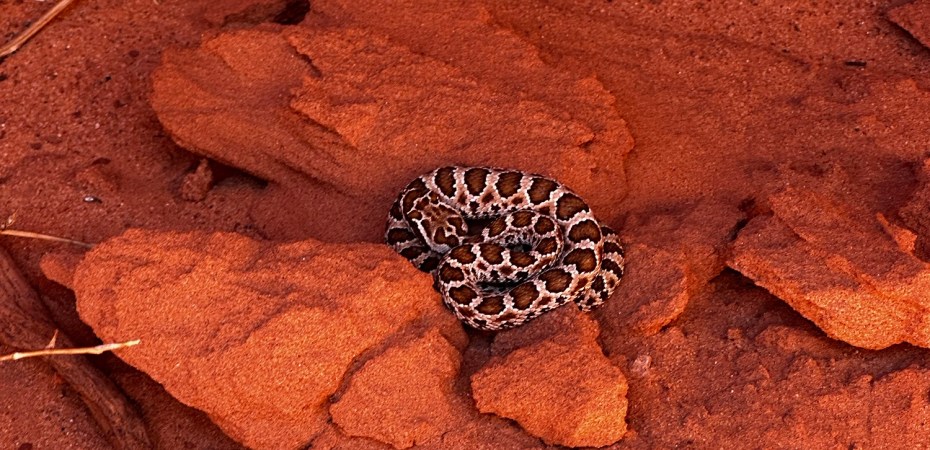
Baby rattlesnakes started appearing in Antelope Canyon in early April. Usually nestled in between small rocks close to the canyon wall, basking in sunlight. Usually curled up asleep.
It is illegal to kill snakes within Glen Canyon National Recreation Area, but hardly enforced.
According to the National Park Service, there are at least four species of western rattlesnakes in Glen Canyon National Recreation Area: the midget faded rattlesnake, Great Basin rattlesnake, Hopi rattlesnake, and the Grand Canyon rattlesnake.
After some research, I believe the rattlesnakes in Antelope Canyon are Great Basin rattlesnakes, who live in communal burrows during winter hibernation.
I’m neither fond of nor afraid of snakes, but the image of 10-12 snakes laying in a pile together does twist my stomach into a little knot. I blame the movie Snakes on a Plane.
There are three known snakes I see in the canyon nearly every day, but now there are only two. The snakes are easy to keep track of because a ladder in the canyon separates them. Maybe they will climb the ladder one of these days, but more likely they’ll stay put until a flood moves them.
The first time I saw one of the baby rattlesnakes, he or she did not have any rattles yet. Later in the month of April after finding a shedded skin, the same rattlesnake had grown one little rattle.
All throughout elementary, middle, and high school, I was never a big science girl. Reading myths, legends, and stories consumed my attention.
So when a guest asked me, “What are the rattles made of?” I joked, “Maracas.”
Luckily they laughed, but they asked me a question I’d never once considered.
Later that night I consulted the internet and found that the rattle is “composed of a series of hollow, interlocked segments made of keratin.”
Uh-oh. I definitely was doodling during molecular biology.
So…what is keratin? The thing they put in fancy shampoo?
Keratin is a fibrous structural protein, serving as the key structural materials to make up scales, horns, hair, feathers, hooves, claws, skin and rattles on a rattlesnake.
The sound of the rattle is not from tiny beads bouncing around like maracas, but from the muscles in the tail which causes the segments of the rattle to vibrate against each other. Since the rattles are hollow, the sound is amplified.
One sunny but not yet hot enough to swim afternoon, I was walking in the canyon with a group of guests when I passed a co-guide going the other way. She smiled, clapped her hands together over her heart and said, “There’s a baby rattlesnake around the corner!”
One of my guests heard this and stopped in their tracks. Their eyes narrowed and fingers tightened around their cell phone. For a brief moment, the thought of taking another selfie left their mind.
Hundreds of people walk through Antelope Canyon each day, and so far none have reported bites. These snakes are acclimated to humans in their home.
According to statistics found on the Natural History Museum’s website, you are eight times more likely to die from a TV set or other large furniture falling on you than a rattlesnake bite.
“I’ll check it out, make sure the snake isn’t in the middle of our path,” I said.
“What if it is?” the guest asked.
“Then we’ll wait, or turn around. Most of the time I see snakes in here, they’re chilling on the side and it’s fine to walk by,” I said, rounding the corner with my eyes on the red sand by my feet.
“Yep, all good to come through,” I said. Guests walked by the baby viper, took a photo, and carried on.
Great Basin rattlesnakes are live-born (a majority of snakes lay eggs) between August and October, so our Antelope Canyon snakes are likely coming up on their first birthday!
I wonder- what kind of party does a rattlesnake like?
Rattlesnakes are an important part of Glen Canyon’s ecosystem. They feed on rodents who carry disease which helps keep the mouse, squirrel and rat population in check. Rattlesnakes feed hungry hawks, owls, coyotes, and foxes as part of a vast, interconnected web of food.
Rattlesnakes are on a small list of animals I see in Glen Canyon.
The Colorado River was flooded by Lake Powell when the Glen Canyon Dam was built in 1963. Few habitats remained intact. Wildlife corridors are now 400 feet under Lake Powell’s waters. The grounds where mountain lions hunted bighorn sheep are buried in deep sediment and cold, refreshing water.
The pronghorn antelope for which Antelope Canyon was named are long gone from Glen Canyon. Once hunted by humans for food, now flooded for a fun recreational lake.
So when I see the baby rattlesnakes in the canyon, I try to stop and really take notice.
Observe (from afar) the way they slink in and out of the cheatgrass. Follow the curves of their slender body wrapped into a neat coil. Watch their irregular spots grow wide instead of long. Say hello to the intelligent creatures who learned to adapt.
 Beth Henshaw
This post is powerful and heartbreaking. Thank you for giving a voice to the wildlife that can’t speak for itself. The story of the baby rattlesnakes and the casual cruelty shown is disturbing, but your respect for their role in the ecosystem is inspiring. Antelope Canyon belongs to more than just humans—thank you for reminding us of that.
LikeLike
Casual cruelty is a great way to describe it- very heartbreaking. Thank you for reading & for your kind words!
LikeLiked by 1 person
Absolutely, Beth. It’s so important to shine a light on these moments, even when they’re difficult to witness. Your compassion and willingness to speak up makes a real difference—I hope more people start to see the wild world with the same respect and empathy you do.
LikeLike