

A record setting, ball busting heat wave let loose on the world this week. Life in Page, Arizona is becoming unliveable in the summer.
The sun rises by 5:06 a.m., so the coolest time to walk my dog is around 4:30 a.m. Usually, I don’t make it out that early. Mallow and I try to get walking by 5:30 or 6:00 a.m. while the temperature starts climbing from 70s to the 80s.
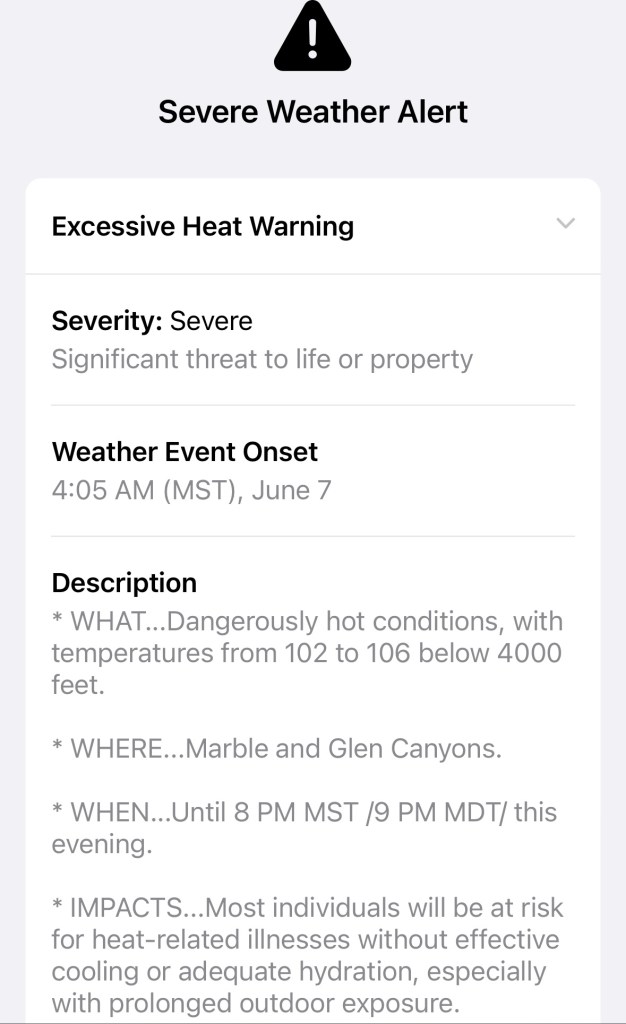
By 9:00 a.m. an excessive heat warning is issued, and air conditioning is life.
Town has been quiet as tourism slows down and people are confined to the indoor life. The key is to turn nocturnal, to sleep all day through the heat and go outside after sunset, but there’s little reprieve when it’s still 95 degrees at 9:00 p.m. Mallow is still panting and walking slow, I’m still sweating, and it’s best to be submerged in water even in the pitch black night. At least the sun is not baring down on our crispy skin. The stars are wonderful companions, but it is not an easy schedule to adapt to.
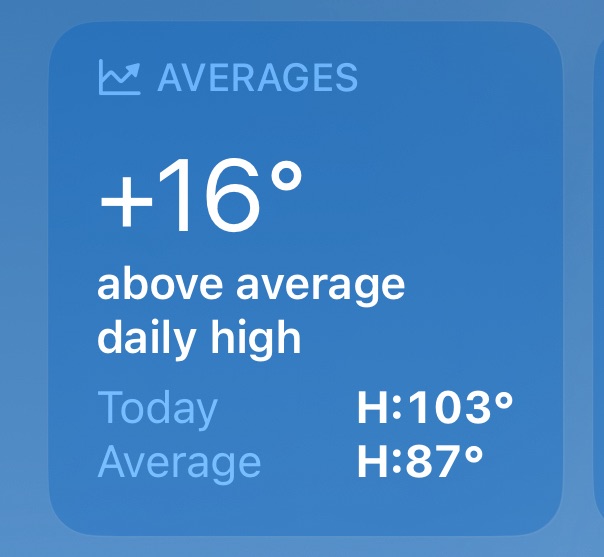
Early June temperatures soaring into triple digits is not normal. Since 1970, the average temperature for June in Page, Arizona is around 90 degrees Fahrenheit.
My dog Mallow peed on the carpet inside our air conditioned sanctuary because the sand and concrete out the back door burned her paws. After three days in a row above 100 degrees, I carried her to the air conditioned car and drove away to find cooler temperatures.
Page, Arizona is becoming un-liveable, fast. And it’s not the only place that’s suffering from extreme temperatures.
Heat Wave Across the Southwest

New heat records set for June 6, 2024:
- Death Valley set a new record of 122 degrees for June 6
- Phoenix set a new record of 113 degrees Fahrenheit for June 6
- Las Vegas set a new record of 111 degrees Fahrenheit for June 6
- In the southwestern states at least 14 million living in 100 degrees or more
- In Mexico, it’s already so hot that howler monkeys and parrots are falling dead from the trees
- 77 people died in the last 10 days from extreme heat in India. 33 poll workers died in a single day in India’s most populous state of Uttar Pradesh.
- Delhi recorded an all-time high temperature of 52.9 degrees Celsius (127.22 Fahrenheit)
- Mexico City is counting down the days until no water comes out of the tap- known as “Day Zero.”
For reference, the hottest temperature ever recorded on earth was 134 degrees Fahrenheit in Death Valley.
Phoenix is in for Another Deadly Summer
It’s only the first week of June and Phoenix is already seeing record breaking temperatures above 110 degrees…so what will this July look like?
Last July, 645 people died (13 deaths per day) in Phoenix due to extreme heat, after a record 31 day streak of temperatures above 110 degrees Fahrenheit. Half of those deaths were people without a home. The bodies of the unhoused would be found on the street with third degree burns as a result of touching the scorching concrete and pavement. The other half of those deaths were people who went outside to go for a walk or had an air conditioning failure.
Phoenix is attempting to open and operate cooling centers for people without air conditioning to sit in throughout the day, but most of them close in the night when temperatures are still above 100 degrees.
Air Conditioning is Life…Or is It?
In an interview with Amy Goodman and Jeff Goodell, they talk about a blackout scenario where cities lose power for two days and then spend three days of restoring power. According to Jeff Goodell, in that kind of a scenario in a city like Phoenix, where there’s virtually 100% penetration of air conditioning, you would have 800,000 emergency room visits and more than 13,000 deaths within 48 hours.
If air conditioning failed in Page, AZ, I would load up the car within the hour and need to drive away in order to stay alive.
Where Can We Escape the Heat Wave?
After leaving Page, we drove to the mountains of Durango, Colorado hoping for cooler temperatures. It was 93 degrees Fahrenheit in the river town, thirteen degrees above the average. They were also suffering from the heat wave. I got on my phone and started joking about moving to South Dakota or Canada. Excessive heat warnings were also in effect there.
I can hear the haters roaring already: “the mere thought of driving or traveling away from the heat is a privileged one!”
First, I’m by no means rich, with an income below the poverty line. Paying for gas to leave and paying rent for a month that I’m not there is a big blow to my savings. It’s not an easy choice, but I have a van and I will use it to drive it to the mountains for the comfort of being able to step outside.
Second, the idea of moving with the seasons is ancient. Humans have lived a migratory lifestyle for the majority of our existence. It is quite natural to leave when a season doesn’t fit your survival needs. Follow the deer down the mountain to escape the blizzards, leave the valley when it becomes too hot and seek cooler temperatures.
It’s only in recent human history that the idea of living in one place for every season for the rest of your life came about. Yes, I can agree that modern day “migration” has become a privilege. It’s not feasible for everyone to have an unoccupied summer house in the mountains with a winter condo at the beach.
Perhaps our society is the thing that has become unnatural. Building a city in the middle of the desert that has no natural occurring water sources to house millions of people may not make the most sense.
There are people who live in Page, Phoenix, and Las Vegas that do not have the luxury to leave when temperatures become deadly.
“Escaping” is not the long term answer. We need climate action now, and not the empty promises countries have been making like “by 2030 we’ll cut our emissions in half.”
The climate crisis is here, and it ain’t pretty.
According to a study published in The Lancet, a medical journal, global heat deaths are projected to increase by 370% if action is not taken to limit the effects of global warming.
What are the solutions to climate change?
- Click here to read about solutions recommended by the NRDC
- Click to read about the 100 companies that are responsible for 71% of global emissions
- Educate yourself on more contributors to climate change.
- Actions you can take for a healthier planet by the United Nations: click here to read.
- Got a yard? Plant some native trees, flowers, etc.
Love REading this Blog? CMake a one-time donation
Make a monthly donation
Choose an amount
Or enter a custom amount
Your contribution is appreciated.
Your contribution is appreciated.
DonateDonate monthly Beth Henshaw
Alright pack it up, let’s move to Alaska!
LikeLike