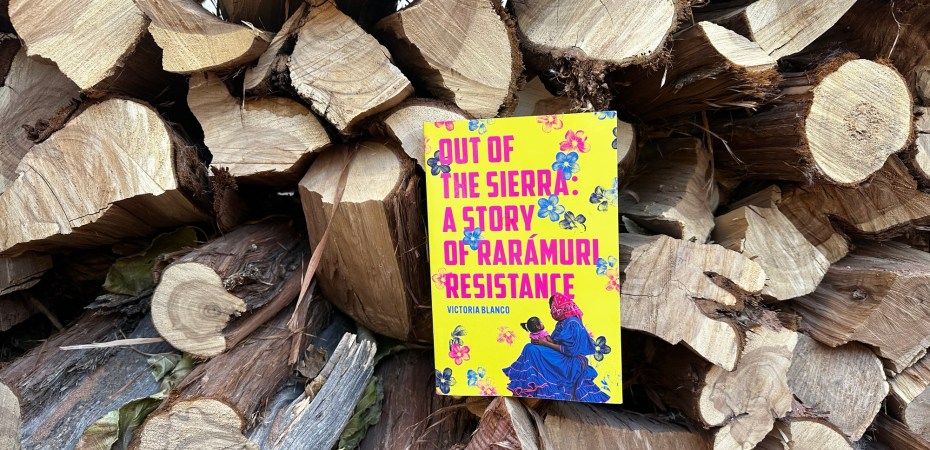
This week I finished reading Out of the Sierra: a Story of Rarámuri Resistance by Victoria Blanco. Set in Chihuahua City, Mexico and the Sierra Madre mountains, we learn about the displacement of the Rarámuri people.
Blanco spent fourteen years writing this book. Fourteen years researching, living and building relationship with the Rarámuri people. The first person who welcomed Blanco into the community was a eight year old girl, Lupita.
This book follows Lupita’s family who was forced out of their homeland in the Sierra Mountains by the cartel, loggers, and ongoing drought conditions. According to Blanco, 35,000-75,000 Rarámuri people have been forced out. Their choices were thin: stay and be held at gunpoint regularly, be forced to give up their garden and limited water to grow thirsty illegal drugs like poppies and marijuana, or assimilate into cities.
What would you choose?
Blanco learned the Rarámuri language to the best of her ability, then translated conversations from Rarámuri to Spanish to English in Out of the Sierra. Talk about an educated woman! I am in awe of her and her process. I consider Blanco to be a leader in how we can approach delicate subjects, learn other cultures and histories, and write respectfully without the capitalistic gain mindset.
Back to resistance. I’m not talking pitch forks, burning flags, and storming the Capital.
Out of the Sierra explores the way Rarámuri families practice passive resistance against colonization, assimilation, and systematic abuse.
Blanco focuses heavily on the women in Rarámuri culture. They sit and sew bright colored skirts, their traditional clothing and colors. Sitting on a street corner, humming, gossiping and sewing resists modern work and go-go-go culture. Making your own clothes rather than buying is resistance. Wearing traditional colors even when they know they will encounter insults and abuse as soon as they leave their home is resistance.
Running was my favorite form of resistance they engaged in. The women and children would plan foot races through the streets. The Rarámuri people developed long distance endurance running in the Sierra Mountains as a way to deliver aid, food, and supplies to their remote neighbors throughout the canyons and mountains.
Running in flip flops and skirts is resisting capitalism and the perceived need to buy Nikes, leggings, a running vest, an Apple watch and log it all on Strava. No race bibs, race fees, course development, or aid stations needed. Betting, cheering, and running together is a beautiful form of passive resistance.
If you’re interested in reading Out of the Sierra: a Story of Rarámuri Resistance by Victoria Blanco you can buy it here and I will earn a small commission.
How can we practice resistance as writers?
I’m enrolled in an M.F.A. program through Western Colorado University, and my class got the pleasure of discussing this question with Victoria Blanco herself.
Her response was to resist all pressures of time. No promise of capitalist gain for a book deal, no publisher or agent could pressure her to hurry up on her book. Fourteen years she spent on this project. Whew! This, I admire greatly.
In Out of the Sierra, the Rarámuri people struggle to assimilate to linear time. They are used to thinking of time as cyclical. The rain will come, the crops will grow, we’ll pick them, winter will return and we’ll rest, spring will come and we’ll plant, the rain will come, the crops will grow, you get the picture. Counting hours for money and not making enough money in a day to eat was foreign to them.
We live in linear time with expectations to meet goals. When I first started writing the Search for Ian book, my writing coach told me to get this out as fast as I can. “You want this story to stay relevant,” she said. She insisted on a sense of urgency in my query letters to literary agents. To convey to them that this story needed to be told now.
Time pressure and artistic expression don’t mix. Her advice did nothing but worry me that I wasn’t writing fast enough. That I wasn’t doing anything fast enough. When I zoom out, what I really want is to write a good book with a beautiful story as a tribute and thank you to all who searched for Ian. This book is incredibly emotional and I need to take breaks to process and to participate in life. Every time I take a break, I return to my manuscript refreshed with better ideas or a deeper understanding.
Deep breath. Exhale.
I will take my damn time writing this book.
Look for resistance
My head is spinning from the atrocities that are coming from the White House. Overwhelmed with the fear and hate coming from our officials, I look elsewhere for leaders.
I am looking for the people resisting.
Today Twin Cities Pride, a non-profit that hosts the largest LGBTQ+ festival in Minnesota dropped Target as a sponsor.
That’s right- they said no to $50,000. Boycotting Target’s decision to end diversity, equity, and inclusion goals.
Instead, 1,450 individuals raised over $70,000 in 48 hours to support initiatives by Twin Cities Pride. Talk about voting with your dollar.
Ever heard of guerilla gardening? Videos are spreading on the internet of people “seed bombing” burned areas in L.A. Technically it’s illegal to put seeds on government or private property. Logically, it’s lovely.

At the Grammy’s this year, Alicia Keys won the Global Impact Award. In her acceptance speech said, “This is not the time to shut down the diversity of voices we’ve seen on this stage. DEI [diversity, equity and inclusion] is not a threat, it’s a gift.”
The Grammys, a seemingly frivolous affair for A-list celebrities, raised over $125 million for disaster relief, honoring the L.A. wildfires that burned more than 15,000 homes and killed 29 people.
Artists will always be at the forefront of resistance.

 Beth Henshaw
I loved reading this, Beth!
Laura Pritchett, PhD
Director, Nature Writing
Graduate Program in Creative Writinghttps://western.edu/program/graduate-program-creative-writing/
http://www.laurapritchett.comhttp://www.laurapritchett.com
Email: lpritchett@western.edulpritchett@western.edu
[cid:eb60eace-bbdd-40c2-8db1-e2161e9452bc]
LikeLike
Thank you Laura!
LikeLike