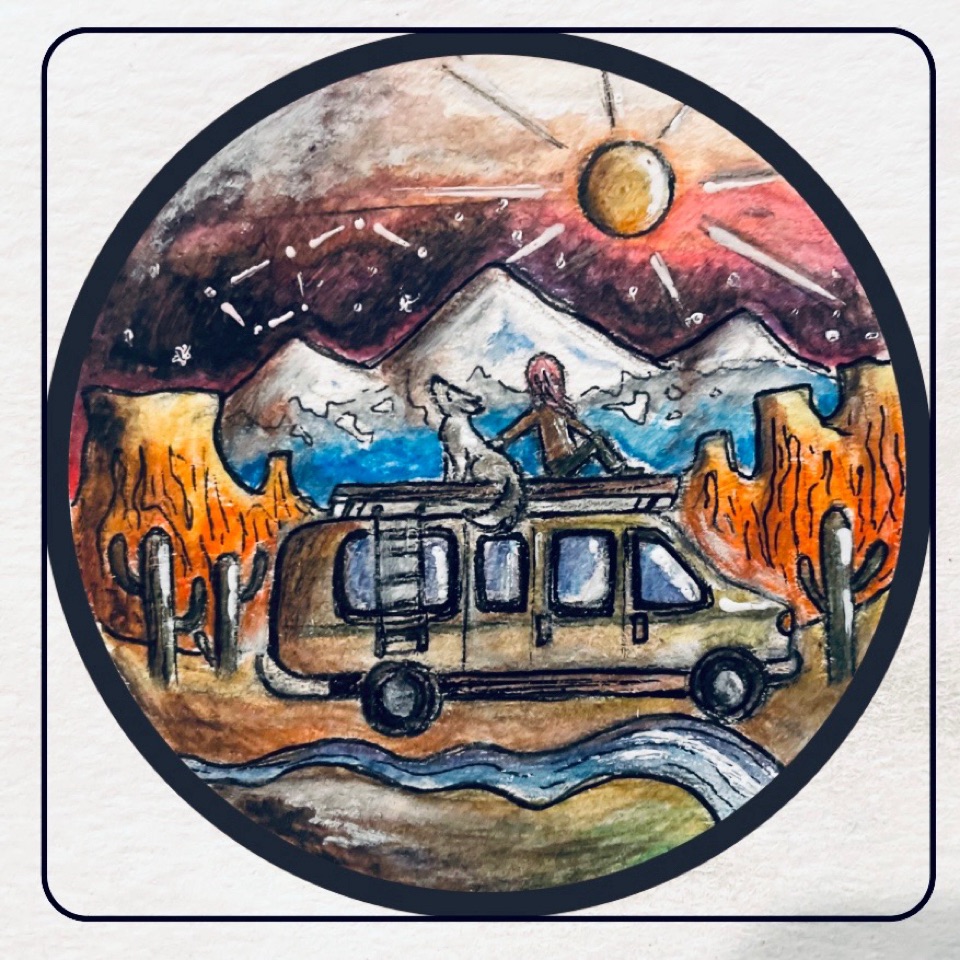
I awoke to a melody of “wheet- wheet” followed by a whistle like chuckle I’d never heard before. Opening my eyes to the dim morning light, I traced the song to the top of the organ pipe cactus I was sleeping next to, its spiny green arms gently swaying in the breeze. A plump gray bird with a long curved bill balanced on top of the spikey yellow-green arm, belting out the desert morning song. Rolling over in my sleeping bag, I propped my head up on my pillow to watch the curved bill thrasher sing to the sun rise over the chocolate brown cliffs; its light cast a gentle glow on the edges of each saguaro and organ pipe cactus.
The Green Desert is peaceful when you have a four-wheel drive truck, twenty gallons of water, a camp stove with a cooler of fresh veggies, a sleeping bag and citizenship. Across the creosote valley and up the jagged mountains less than twenty miles from where I slept, the Green Desert is a death trap for border crossers. Devoid of water, shade, and edible plants, hundreds of desperate people cross the border through this treacherous terrain each year.
The sound of water bubbling in the Jetboil broke the deserted silence. Sleeping bags and tents unzipping followed as my friends Stephanie, Lena, and Jaden woke to the smell of coffee. Eggs, potatoes, and onions frying in oil harmonized with the whistling song of the curved bill thrasher still balancing atop the organ pipe.
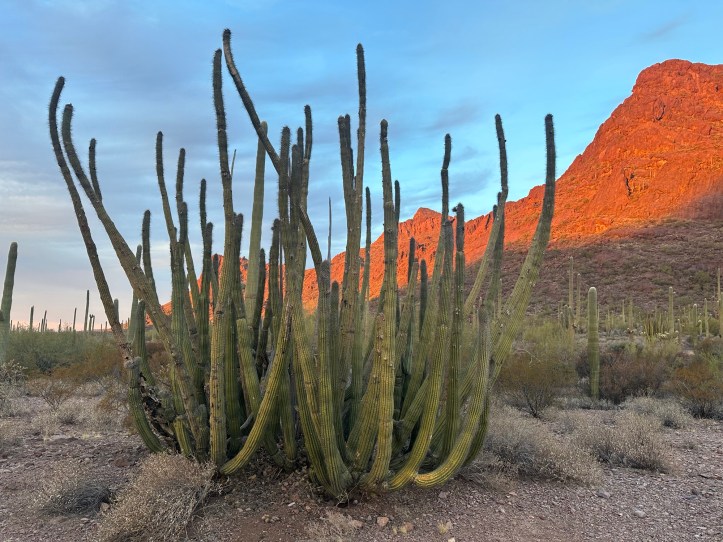
A cactus that can only be found in this little slice of Arizona, twenty three miles north of the border between the United States and Mexico. A treasure for our country, this species of cactus is protected by the federal government as a national monument for its rarity. Along with the senita cactus, this monument protects both columnar cacti who grow many arms from the base that cluster together in thickets.
Wiping the sleep from our eyes, we packed up camp after our second cup of coffee and closed the back hatch of our pick up truck. Loading up in one car, we headed south for the border. I was curious to see how things had changed down here since I was here last.
In January 2021, my partner at the time, Ian and I arrived five days after Biden announced a “pause” on building the wall. But there didn’t seem to be a pause in construction. We followed semi-trucks through a wilderness area south to the border.
Wilderness areas by designation are to be “free of human development such as roads, buildings, and power lines.” But there we were, following semi-trucks through hundreds of dirt roads that criss-crossed through the wilderness area, all the way to the border where we saw a small city of double wide trailers, trucks, tractors, bulldozers, piles of steel, and semi-truck after semi-truck delivering supplies.
“I thought Biden ordered a pause on building,” I said to Ian, who was sitting in the front seat.
“I thought wilderness areas were protected,” he said, shaking his head. During Donald Trump’s first presidency, he declared a state of emergency to build the wall between Mexico and the United States, which is used during war times that overrides any public land designation.
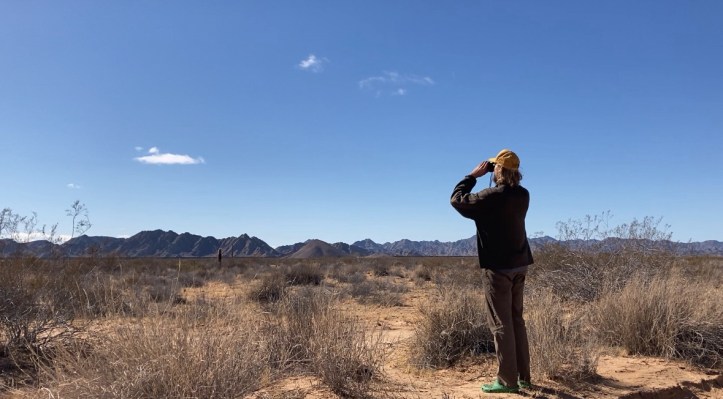
We parked, not allowed to go within a mile of the border, to watch the construction through our binoculars. The wall was being built through our cherished public lands, cutting through the delicate Sonoran ecosystem and bulldozing down ancient saguaros, senitas, and organ pipe cacti to make way for an ugly wall.
I returned to the border in December of 2024 with Stephanie, Lena and Jaden. None of them had never seen the wall or the organ pipe cactus before.
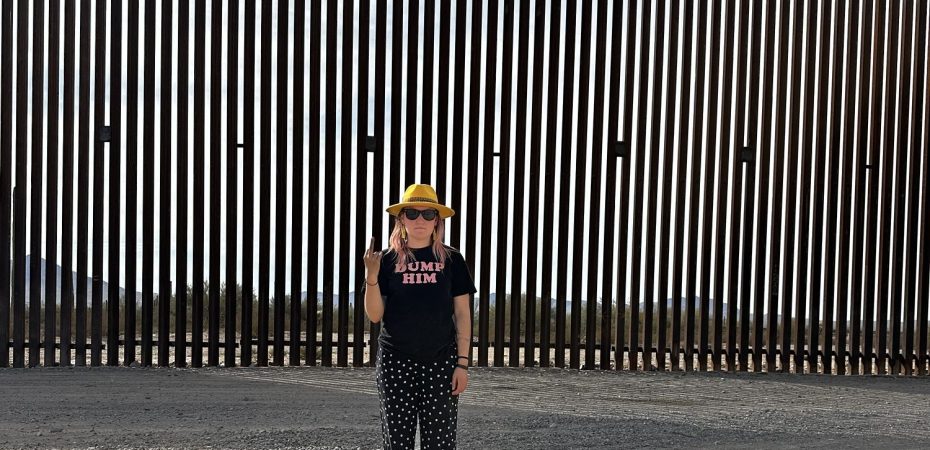
I don’t think I’ll ever see the wall and not experience shock. From a distance, an unnatural black line cuts through a mountain. White Border Patrol cars sit on top of hills and watch as you drive closer.
Up close, the wall is intimidatingly tall. Though the word wall doesn’t really match. A wall implies a solid object that obstructs sight, where this border wall is not continuous. Big slates separate the wall, almost big enough for me to slip through. My arm and shoulder easily pass through.
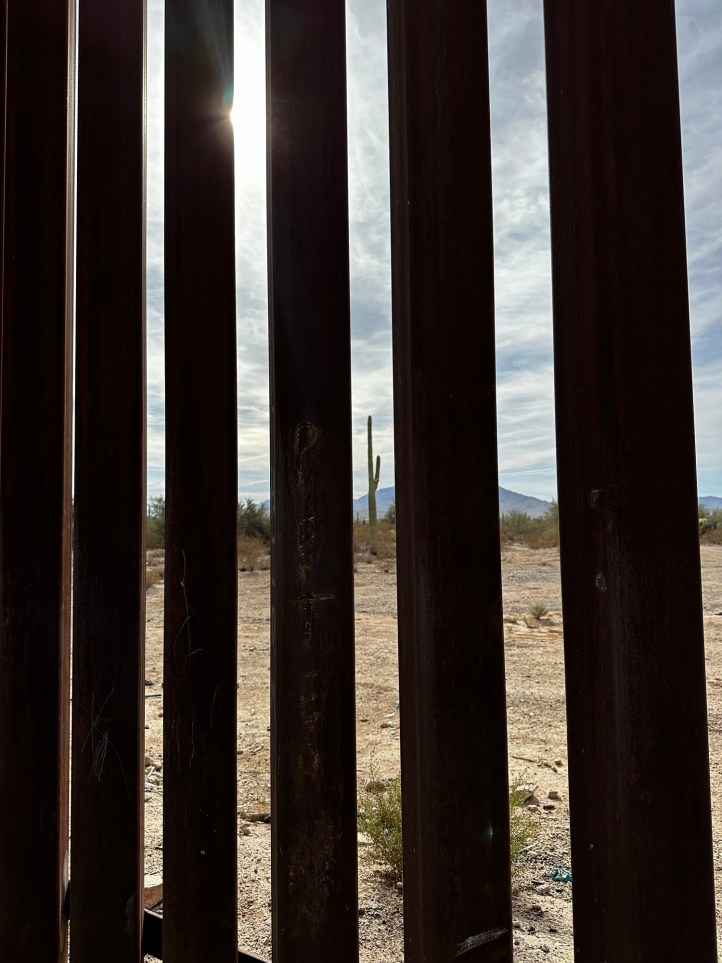
Within five minutes of walking along the border wall, we came upon two pieces of the vertical slats that were cut and pulled back on the Mexican side by what looked like a handsaw. Dozens of people could fit through here. As we examined the pieces of the wall bobbing up and down in the wind, plumes of dust shot up in the sky as Border Patrol cops sped toward us on the washboard roads.
“Oh shit, we should go,” I said. But the Border Patrol truck didn’t even slow down as it passed us. Because we’re white? If we found an obvious breach in the wall within five minutes, wouldn’t Border Patrol agents who live and drive here every day have noticed this?
“Why don’t they bother fixing the wall?” I wondered out loud.
According to the Cato Institute, “These billion dollar walls are easily cut through with conventional power saws that cost as little as $100,” and “In 2022, the border wall was breached 22 times per day.” According to data obtained by the Cato Institute through a recent Freedom of Information Act request, “Despite the construction of these exceedingly expensive new barriers, crossers are breaching the border wall more frequently than before.”

So the wall doesn’t even work.
Habitat of rare and fragile cacti destroyed, wildlife migration paths disrupted, and archeological sites destroyed- for what?
According to the National Park Service, archaeological evidence places human beings in this area approximately 16,000 years ago. Projectile points, seashells, pottery, and rock art have been found within the monument. The presence of seashells and salt brought from the salt beds of Sonora Mexico represent a time in human history without arbitrary border walls. Rivers, mountains, and oceans have served as natural and logical borders for thousands of years. Prehistoric people figured out how to walk the land and trade goods with neighboring nations, so why can’t we?
What is the wall for if not to stop illegal border crossings? Border Patrol agents aren’t standing at the wall, fixing broken pieces to stop people from entering. They let people through, as evidenced by the obvious breach, then chase them through the most grueling and unforgiving stretch of desert where they expect most crossers will die or give up due to the extreme heat and lack of water.
Thousands of roads cut through the once protected Cabeza Prieta wilderness area and Organ Pipe Cactus National Monument so Border Patrol agents could play a game of cat and mouse chase.
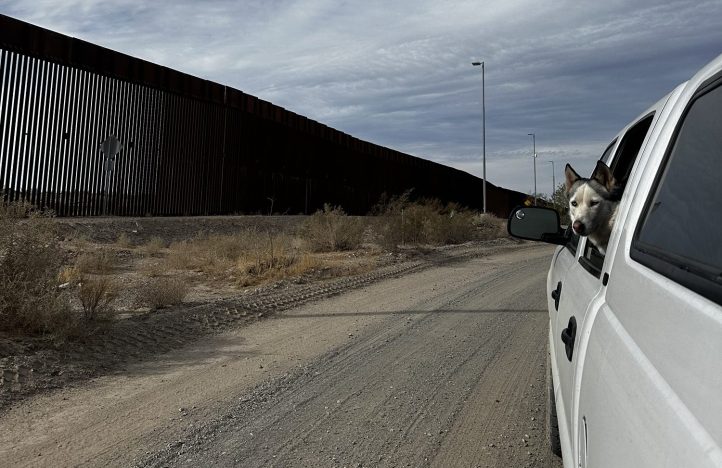
I couldn’t help but wonder if the border wall was all just for show. A symbol of power, wealth and status designed to scare people. Think of the great minds that were used to design and engineer this waste of materials, destroying what a park was put into place to protect.
We the people didn’t do this. If I been asked to vote on a multi-billion dollar wall being built along the border, I would’ve voted fuck no.
We the people are prisoners to the two party political system. Though Trump’s administration built 458 miles of the border wall, the Biden administration added an additional twenty miles of the border wall in October 2023.
Standing in the shadow of the wall, I felt trapped, not protected. I couldn’t help but wonder if the wall was built to keep others out or to keep us in.
The monument was heavily militarized and developed, nothing like the mission statement for National Parks states: “The National Park Service preserves unimpaired the natural and cultural resources and values of the National Park System for the enjoyment, education, and inspiration of this and future generations.”
I shudder to think of all the immigrant women across the country currently pregnant with the next generation.
On January 20, 2025, Trump’s first day of his second term as President of the United States, he signed an executive order attempting to end birthright citizenship for the children of immigrants in the United States. This violates the Fourteenth Amendment to the U.S. Constitution, which was introduced in the wake of the Civil War “to establish that all persons born in the United States and subject to its jurisdiction are U.S. citizens, and to guarantee equal rights to all citizens and equal protection of the laws to all persons under U.S. jurisdiction.”
Racism in the White House is the emergency, not immigration.
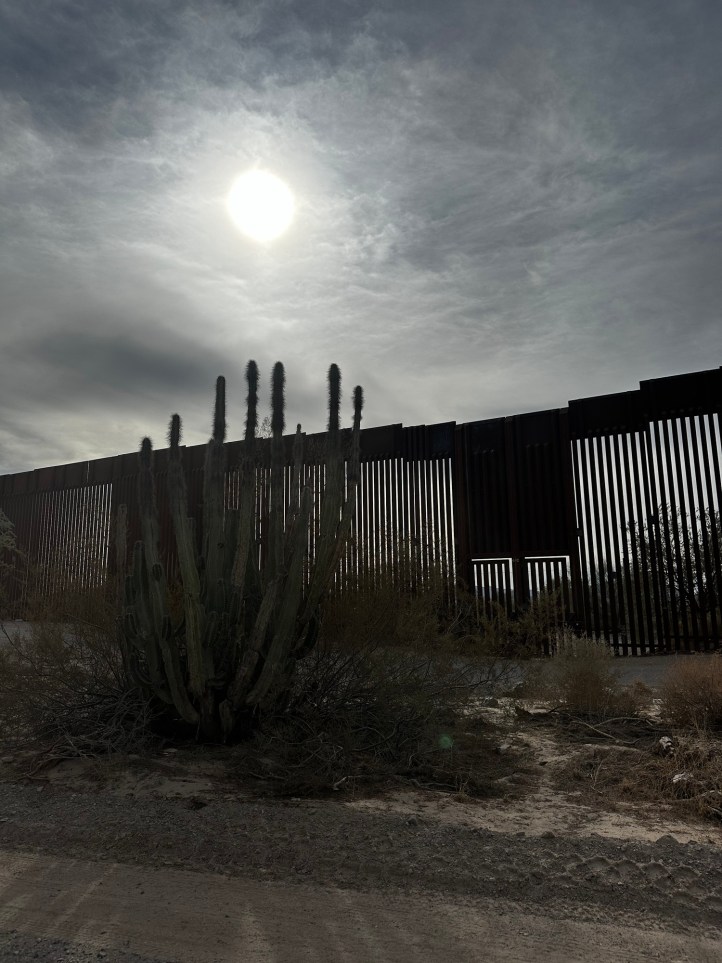
After a day of feeling disgusted, horrified, and confused by the monstrosity that is the border wall, we left to find camp outside of the monument on BLM land.
Passing trailers, camper vans, and trucks, we drove to the end of a dirt road in the creosote flats, hoping to find solitude. Away from humans.
The last campsite on the road was empty, under the shade of an ironwood tree next to a dry wash old palo verde. When we stopped the truck and stepped onto the dry dusty floor, evidence of human presence was everywhere. Not in the trashy way of discarded refrigerators, crushed beer cans, and box springs of old rusty mattresses.
Intentional rocks sorted by shape and color outlined the ancient creosote, forming walking mazes and hearts. Someone used the volcanic rocks from the wash to build an oval oven for a fire. Sun bleached bones and seashells were lovingly placed in the branches of the ironwood. Some rocks were painted in bright colors and placed at the trunk. In the crook of a branch was a plastic container with a journal and pen.
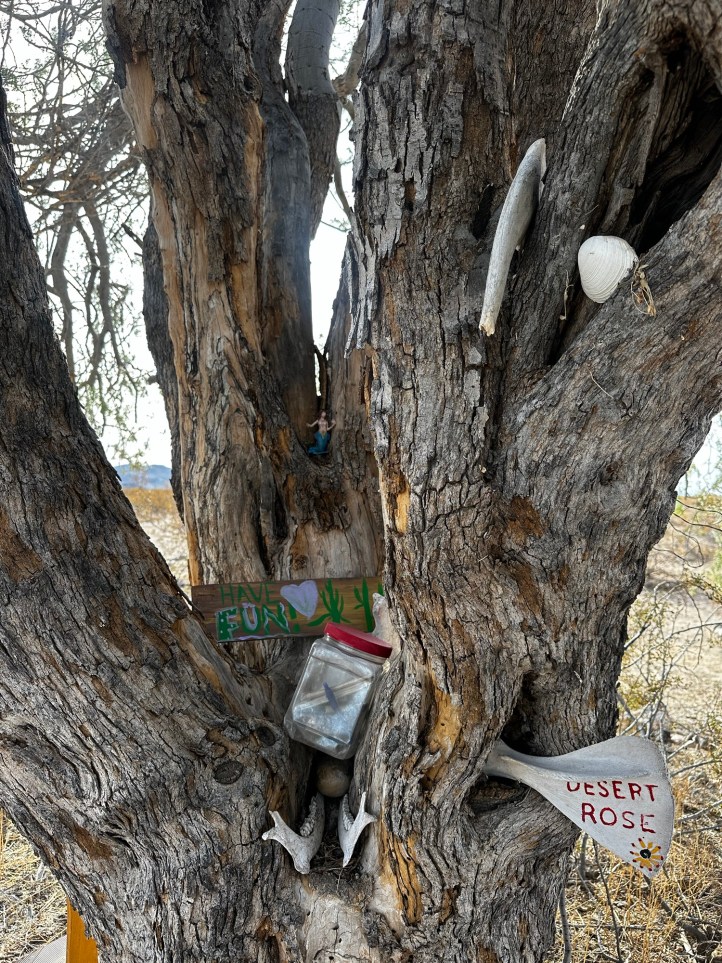
Inside was the story of this place: a distraught mother brought her drug addicted son here. They camped here to avoid temptation, to detox, to stack rocks and paint rocks and who knows what else. They returned here for years, spending weeks at time sleeping underneath the ironwood’s shade. They buried their beloved dog and horse here, both graves we found as mounds in the dirt with rocks and conch shells placed on top. One of the graves had a hand painted headstone that read, “MAN’S BEST FRIEND.”
The mother wrote her last line in the journal: “But I never had to bury my son.”
The fruits of their labor remained here for others to enjoy and build upon. The spiral notebook was full of other entries from visitors who returned here for five years, eight years, and one said they’d been coming to this spot for twenty years.
When I finished reading the story, Jaden took the beaded necklace that he spent hours making the previous day off and hung it in the tree “for him.” Stephanie hung an ornament she made on a branch and Lena got to work painting a rock. I sat under the tree to write, stunned by the duality of the day.
The care for this place was palpable. I took a deep breath, grateful for the reminder of humanity’s core strength: love.
Fierce, protective love leaves a mark on the land just as much as fear and hate.
I look forward to a future where the border wall crumbles down, and people from both sides come to plant cactus and make art together in the scar. When I finished writing, I looked to the wash where white rocks called my name to be picked up and lovingly placed among the others.

Continue reading about the border wall…
- The Line Becomes a River by Francisco Cantu: a book written by a man who went to school to study immigration and joined the Border Patrol for four years to better understand the ins/outs of the border wall. It provides dark details for a very complicated issue and explores the ethics of Border Patrol practices. I read this book in three days- it captured me and I couldn’t put it down!
- The Devil’s Highway by Luis Alberto Urrea : this book serves as my foundational knowledge of the border crossing reality specifically through Arizona’s wilderness at Organ Pipe National Monument and Cabeza Prieta Wilderness. (These are affiliate links and I will earn a small commission if you purchase them through this link.)
 Beth Henshaw
Thank you, Beth, for the good and important work you do!!
LikeLike