Subscribe to get access
“Death ends a life, not a relationship.”
This is the thread that has stuck with me most throughout meeting online for the support group for widows. It’s a quote I keep coming back to and reflecting on.
The instructor of the course discussed the idea of “continuing bonds,” a grief theory which came from a dissatisfaction with the five stages of grief. Continuing Bonds, a book published in 1996, written by Phyllis R Silverman, Dennis Klass, and Steven Nickman (bereavement scholars) expanded the general understanding of the grief process. (If you purchase the book through that link I will earn a small commission)
The five stages of grief are less popular these days and no longer the dominant belief system. “Letting go” is a big part of the “acceptance” stage, but many grievers and grief studies researchers argue that letting go is not necessary (and perhaps not possible) for moving forward.
Continuing Bonds argues that we will think of our loved ones as life events pass without them. People do not stop existing in our minds, hearts, and lives. And it’s possible to continue a relationship with our loved ones who pass.
Personally, I love this idea and am learning every day what this looks like in practice.
My dad died when I was seventeen, and my grief for missing him has spiked throughout life’s big moves: graduations, moving states, getting a dream job, applying to grad school. Sometimes these exciting life events are tinged with sadness because I wish he was there to see it. I wonder what he would say and I know he would be proud, but his absence feels more obvious during these moments.

When I think about how I can continue to have a relationship with my dad, I think about reading and writing. Though I can no longer debate topics and discuss plot lines and give my dad my essays to read, I still feel connected to him whenever I engage in reading and writing. I particularly feel connected to him when I read on the beach with my toes in the sand. It’s something that we would do together if he was alive today.
The idea of continuing bonds is that the death is unchanging, but the process of how we relate to our loss does evolve.
When my dad died, it was too painful to write for several years. Now writing is something I turn to when I experience pain because I know it helps.
When Ian first went missing in the mountains of Colorado and wasn’t found, I had to get as far away as I possibly could. I drove to the east coast to be with my family by the ocean and the Blue Ridge mountains- familiar grieving grounds. At first it was painful to think of the mountains where Ian lost his life. The first, second and third time I returned I cried a lot. I dreamt of the search when I camped there, as if I were re-living it.
Then, after about a year, I returned and it felt like home. Looking up at Hesperus felt welcoming, soothing, calming. I could feel Ian’s spirit there. I thought of how alive he felt running in these mountains. I felt connected to the way he lived in these mountains more than I felt connected to the way he died. I summitted Hesperus with two friends and on the way down I cried thinking of Ian taking some of his last steps down the mountain. I’ll probably summit the mountain again, with different people and the flowers will look different and I might be more in shape and it might feel better or I might not make it up at all but the relationship with Hesperus and Ian dying nearby will continue to evolve.
How do we learn to find connection again after death severs the relationship?
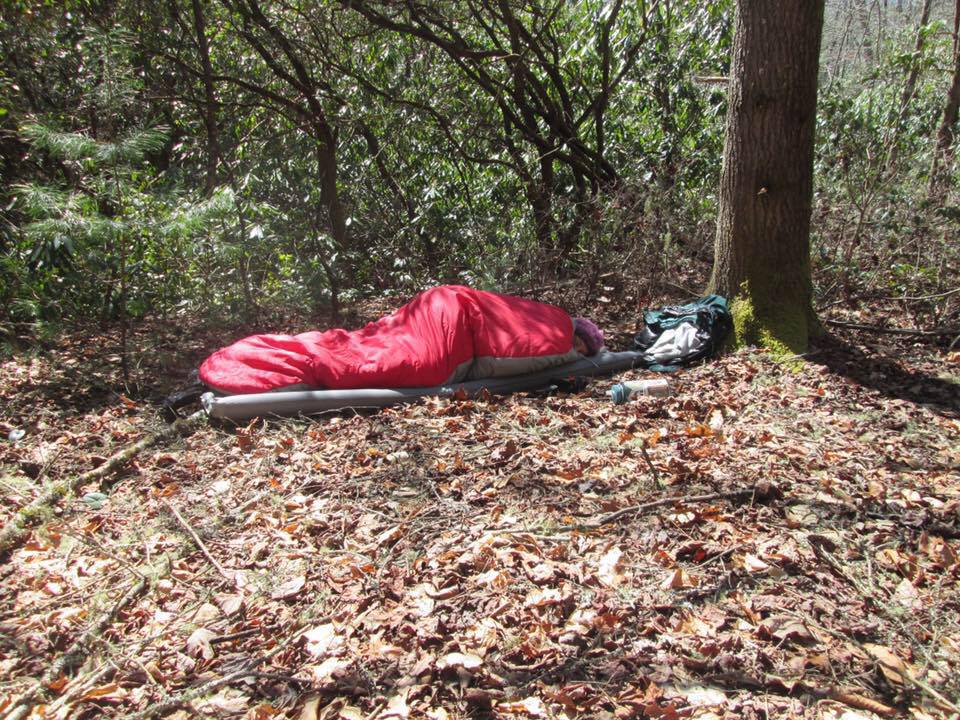
On my first backpacking trip in college, my instructors set us up in the woods to complete a solo. I remember laying underneath an oak tree, watching the bare branches sway against a blue sky. For the first time, I talked to my dad out loud. I sobbed and laughed as I caught him up on what he had missed in our family. No one ever suggested I try that, I just held it in until one day I exploded. Talking to him really helped. I felt connected, I felt like he might be able to hear me, that maybe the trees could serve as a messenger between worlds. Whether it’s true or not doesn’t matter. It helped.
This is the photo my instructor snapped of me on my first solo (I fell asleep after hours of crying):
The best way I find connection to my dad and Ian is by living in the values they taught me.
My dad was infamous for turning a three hour drive into an eight hour drive by stopping at every museum and historical marker along the way. It was so annoying as a kid! But damn did I learn a lot about the world. These days I find myself whipping my car off the highway just to read historical signs, not just to honor my dad but because I’m curious. He instilled a love for learning in me, and when I nurture that love for learning I can still feel his influence in my life.
My dad also taught me to be of service. I logged hundreds of hours of community service a year with him from the age of ten. To this day, when I notice myself feeling lonely, disconnected, or generally enraged at the state of the world- I volunteer. When I’m connected to communities that are serving missions to better the world, I feel more optimistic, hopeful, and helpful. I’m a board member on the Glen Canyon Conservancy- an agency that is working to protect Glen Canyon for future generations to come. When I’m involved with service oriented community projects, I can feel my dad with me in spirit.

Ian and I loved sleeping outside under the stars. We agreed that was the best use of our time. Camping and cooking outside helped our nervous system feel regulated. We enjoyed reading books about the geology, plants and animals. Learning about the natural world helped us learn about ourselves and our role in each ecosystem. These things felt painful without Ian at first, but continuing to camp, immerse myself outside and learn more about the environment does help me stay connected to Ian.
Stories are a huge way I stay connected. I like to write about my dad and Ian. I enjoy sitting around a campfire or dinner table and laughing about the things they said and did. Speaking these memories out loud keeps them alive in my mind and heart.
Ian always challenged me to be active. 50 miles on a bike was just a casual afternoon for him. Seven days backpacking was a vacation for us. I was physically strong and healthy when I was in relationship with him. This has been one of my biggest challenges since he died. Grief shows up as laziness for me. I have hardly been able to get my ass on a bicycle since he died.
Nearly every time I have gone on a run since he passed, a singular raven has visited me. Quietly the raven will fly from rock to rock, watching me run. When I notice, the raven usually gives a friendly “caw!” and I think of it as Ian saying, “Hell yeah, go Beth go!”
It’s these little moments that remind me Ian and my dad have forever altered the way I walk in the world. And I’m so grateful for their influence. And perhaps forever deeply saddened by their absence.
But I’m learning how to connect with them through the landscapes we loved to explore together. When I miss my dad, I hit the highway and don’t stop until the land crumbles into the sea. When I miss Ian, I pack my backpack and head out for a canyon walk. It’s in the mountains, both blue and rocky, that I can visit them.
 Beth Henshaw